
Challenge
A mid-market enterprise resource planning (ERP) platform was experiencing rapid growth.
However, there weren't any viable options for reliably integrating with the mid-market, front-running e-commerce platform.
The only available solution was a hurriedly thrown together platform, incapable of handling the demands of sudden, high-volume spikes in sales orders.
Thus, an opportunity had emerged to create a solution to a pressing need that the incumbent was incapable of meeting.
Result
Following a brief succession of tight development cycles, a connector solution was released. The system accessed deep within the e-commerce platform's data store, using order and inventory APIs to enable critical data collection.
To ensure proper synchronization, duplicate ERP and e-commerce data were centrally stored, serving as a bridge between the two systems. Specialized interfaces exposed the calculations, making the underlying numbers and their rationales transparent.
Additionally, the new system was designed to continue processing transactions using automatic retries, even when connections clearly started to fail.
Hosted on a virtual machine in a remote data center, the solution was designed to handle onboarding with minimal time required. The platform's capabilities were extensive:
- Control over fulfillment from online shop, while managing shipping fulfillment process and inventory management in the back office ERP
- Ability to map inventory counts across multiple warehouses, ensuring ERP backend and storefront quantities match exactly
- Fine-grained control over which sales order to use as starting point for synchronizing data
- Side-by-side analysis tool enabling global visibility of item matching between both systems and inventory counts
- Online payment processing and refund capture with transactions reflected in accounting
- Balancing-to-the-penny with streamlined reports that spot even the slightest difference
- Selective control over which back-end inventory items surface in online storefront for smarter decision-making
Impact
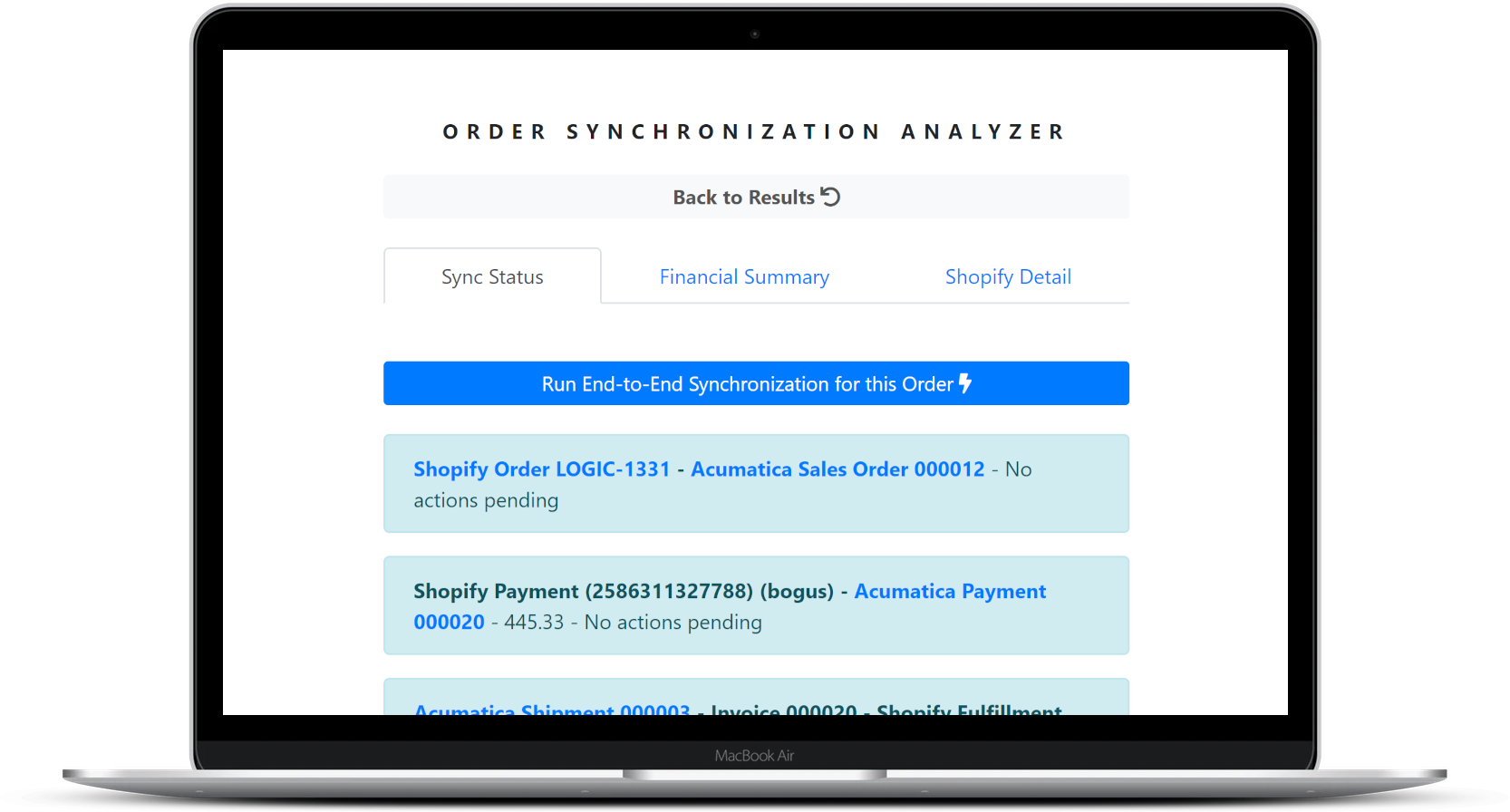
The completed product was a fully developed solution capable of addressing a range of integration needs. Backend processes were managed using open-source Hangfire for queuing and asynchronous execution.
To achieve maximum robustness, the integration solution would include an imprint of records before upload, with sufficient source trace data to project the future footprint in the destination system. By running both the backend and the front processes in proximity on the same virtual machine, the communication loop was tightened.
The final deployment of the solution established a new set of norms for ERP integration. Carefully straddling two systems clearly justifies a standalone system with split duties and split resources. However, in practice, the division of duties is rarely evenly split between the two.
Moreover, with an in-between platform, the underlying modules in each system would generally require special attention to ensure all data is safely synchronized. In the future, implementing suitable automation that runs at a configurable frequency to ensure reliability becomes virtually unavoidable.